UDICO, an IDICO member company, expands from power infrastructure into the DPPA cooperation model for businesses in IDICO’s industrial parks (IPs)
EXPORT REQUIREMENTS ARE INCREASINGLY LINKED TO GREEN POWER
In 2025, electricity demand in Dong Nai Municipality reached approximately 20.2 billion kWh. Meanwhile, peak electricity demand is forecast to continue rising significantly in the coming years, while local power generation capacity is unlikely to increase at a corresponding pace.
For manufacturing enterprises, the energy equation is therefore changing. The challenge is no longer simply how to secure a stable power supply, but also how to control costs and gradually meet the growing demand for clean energy from customers and global supply chains.
The ability to supply and manage energy is gradually becoming part of the competitive advantage of industrial real estate.
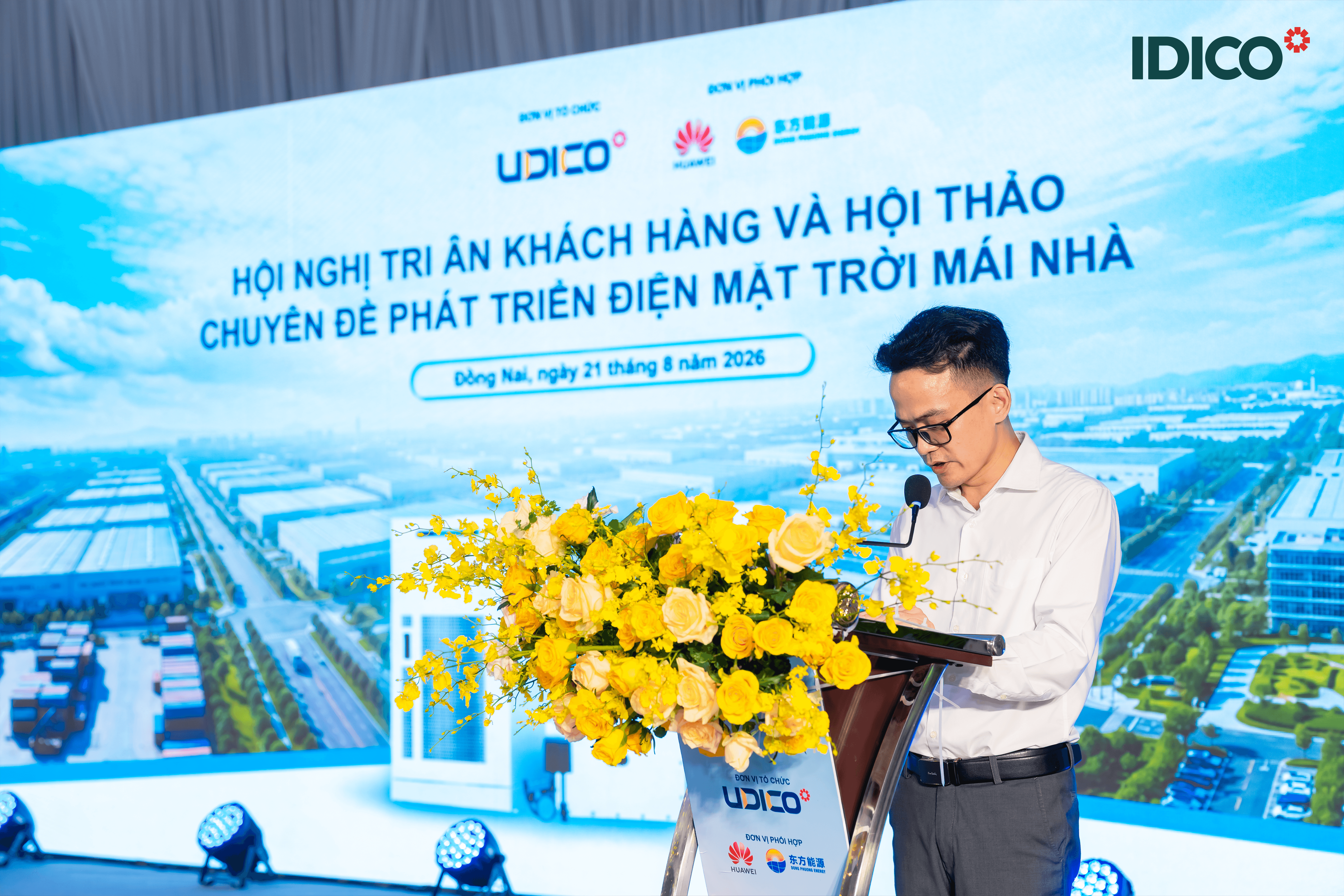
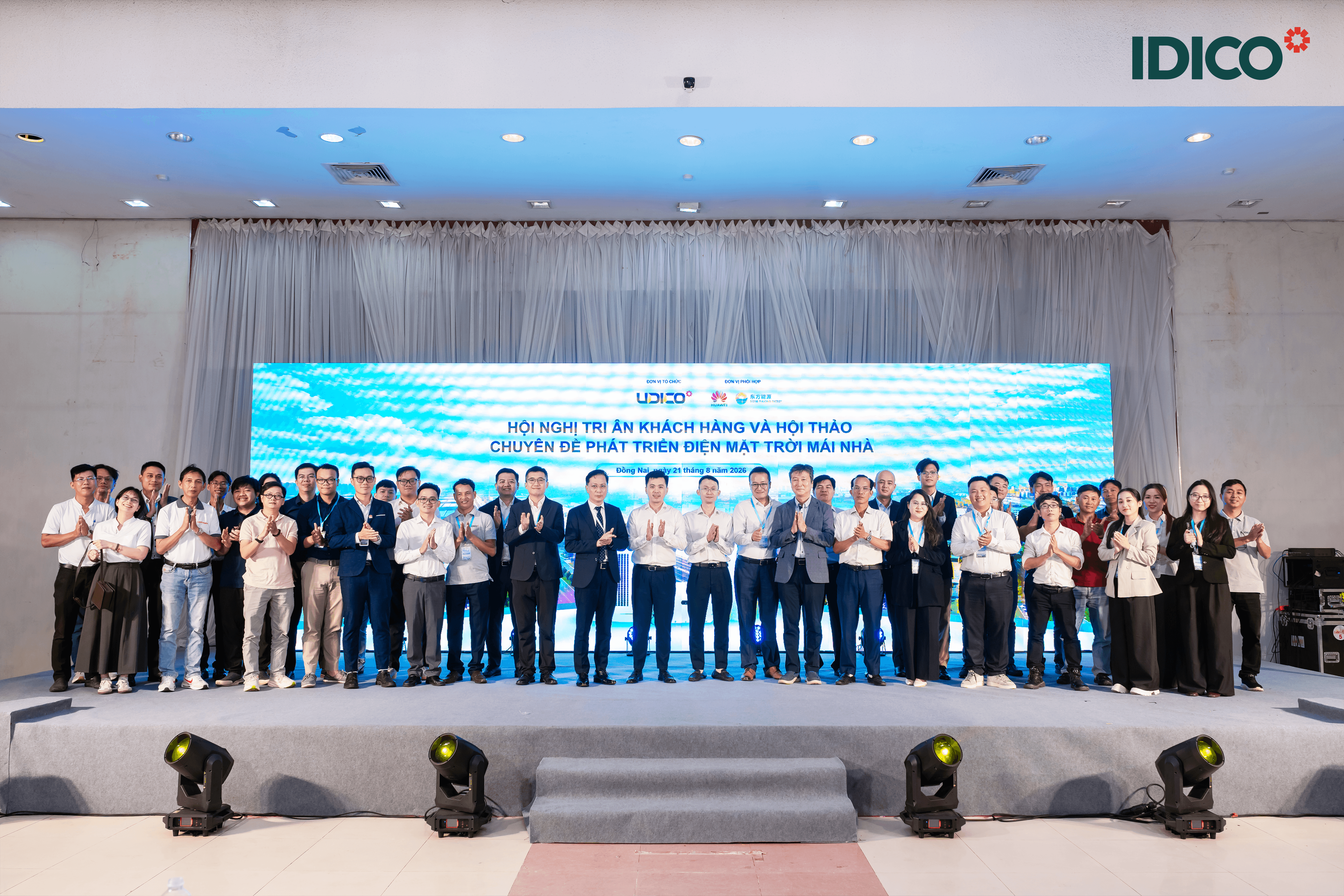
Against this backdrop, UDICO, a member company within IDICO’s industrial ecosystem, in collaboration with Huawei and Dong Phuong Energy, organized the Customer Appreciation Conference and Workshop on “Rooftop Solar Development Strategy – Cooperation Opportunities between UDICO and Industrial Park Tenants” in Dong Nai Municipality on August 21, 2026.
The event brought together representatives from the Department of Industry and Trade of Dong Nai Municipality, technology experts, and businesses operating in IDICO Nhon Trach 1 & V IPs in Dong Nai Municipality.
OPPORTUNITIES FROM THE NEW REGULATORY FRAMEWORK
Changing market demand is taking place alongside the continued development of the regulatory framework. New regulations on Direct Power Purchase Agreements (DPPA) are creating greater opportunities for developers and IP stakeholders to develop investment, power trading, and renewable energy consumption models suited to actual operating conditions.
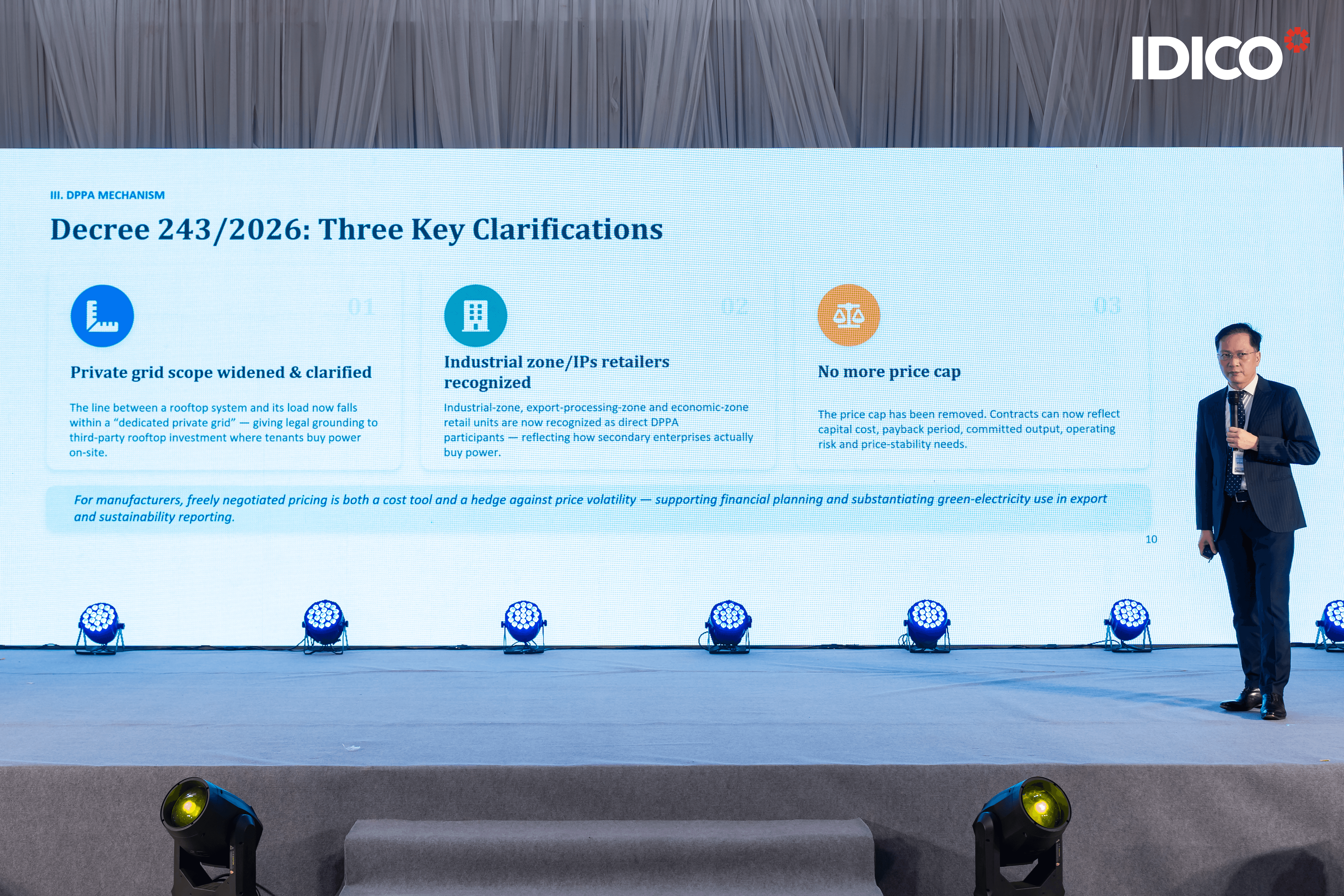
At the workshop, a representative of the Department of Industry and Trade of Dong Nai Municipality shared updates on energy policies and the DPPA mechanism. Newly issued Decree No. 243/2026/ND-CP expands the scope of participants in DPPAs through dedicated grid connections. The regulation allows renewable power generators to directly deliver and receive electricity with large electricity consumers or retail electricity units in industrial and industrial-cluster areas without using the national grid. It also adds provisions allowing retail electricity units in industrial and industrial-cluster areas to participate in the investment and development of renewable energy projects to supply large electricity consumers within these areas.
These regulatory developments are also creating new requirements for IP infrastructure developers: beyond developing land and technical infrastructure, they need to progressively expand services and utilities that support businesses in their energy transition.
FROM POWER INFRASTRUCTURE TO ENERGY SOLUTIONS FOR IP TENANTS
UDICO’s advantage is built on power infrastructure that has been invested in, constructed, managed, and operated within IDICO’s industrial ecosystem for more than 20 years. This foundation enables UDICO to expand from its role in supplying and operating power infrastructure into the development of renewable energy solutions for IP tenants.
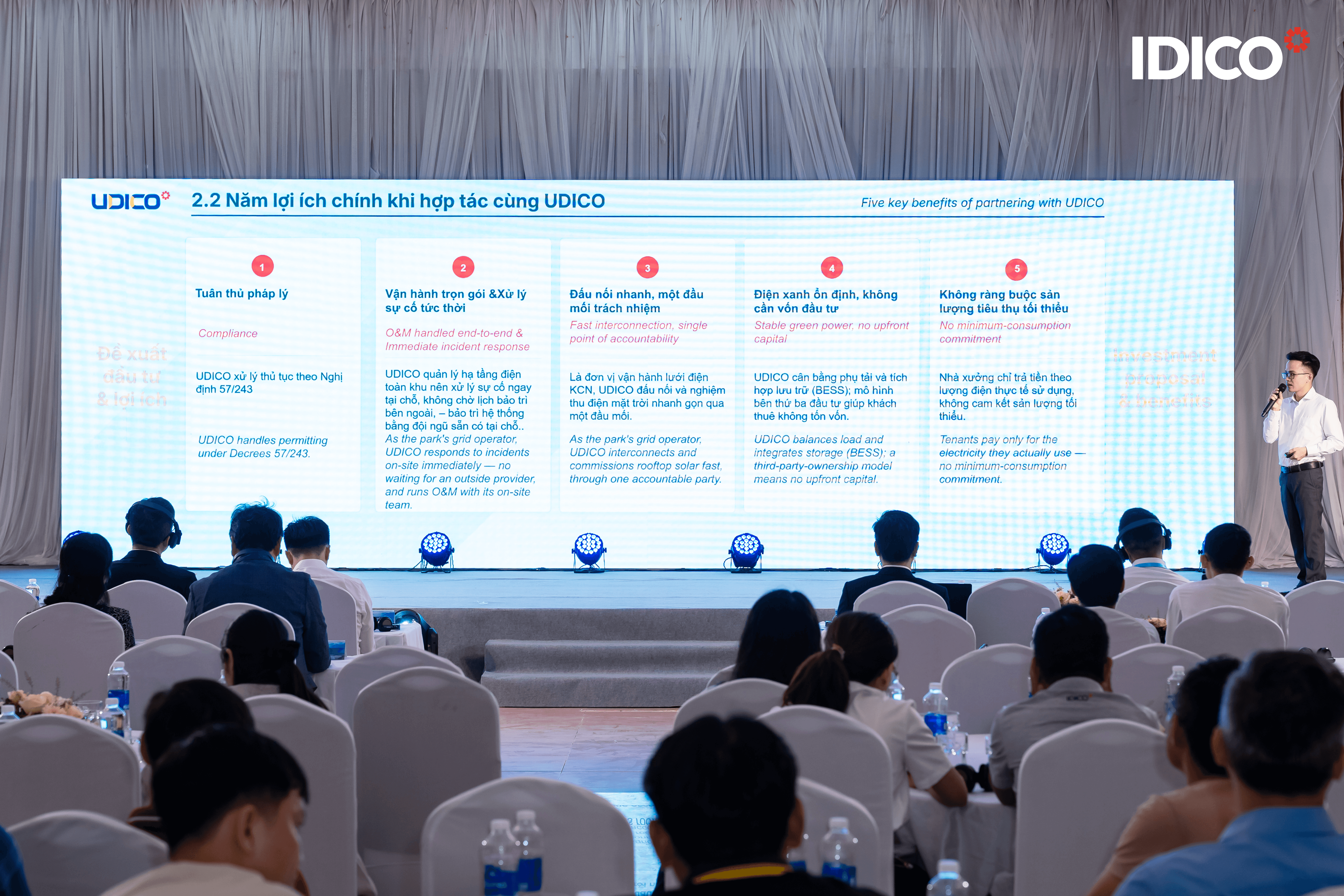
At the workshop, UDICO introduced a rooftop solar development model under the DPPA mechanism through a dedicated grid connection. Under the model, UDICO takes responsibility for the process from site assessment and investment to grid connection, operation, and maintenance. Power is delivered directly to on-site loads through a dedicated line, leveraging the existing power infrastructure of the IP to facilitate implementation while reducing the initial capital investment required from businesses.
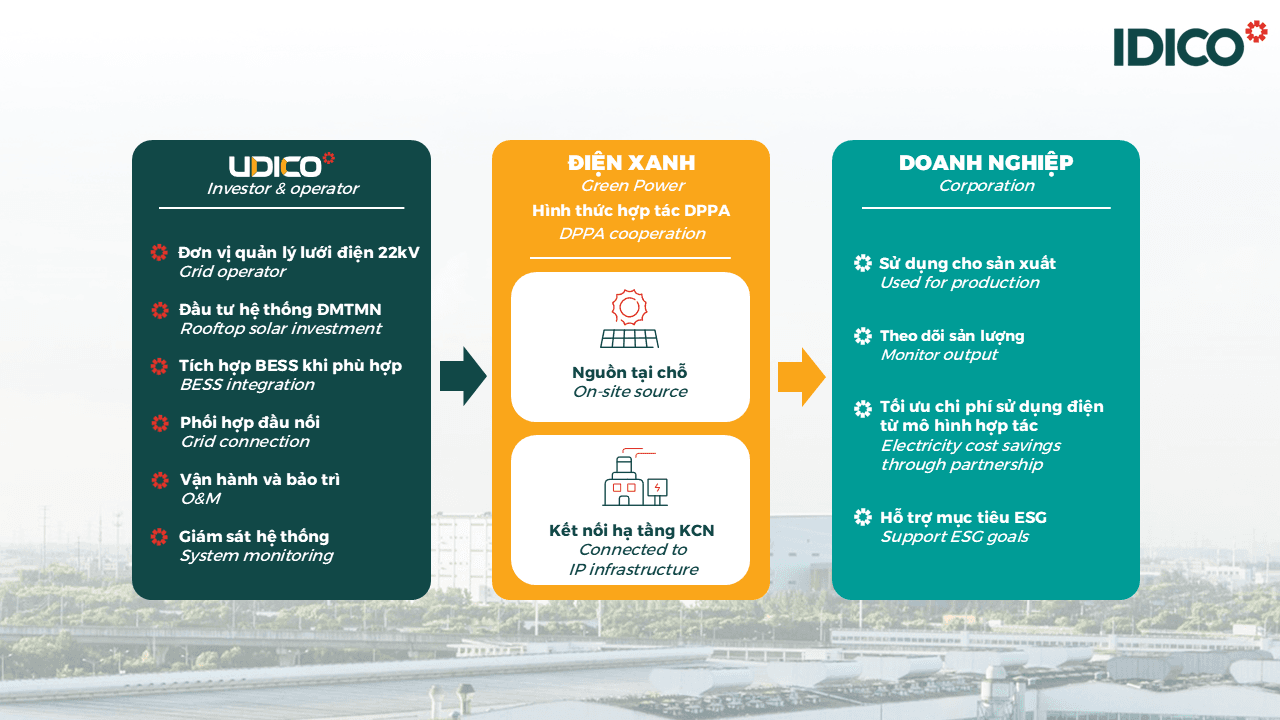
Under this cooperation model, UDICO is responsible for assessing rooftop potential, analyzing electricity demand, investing in the system, coordinating grid connection, and operating the system throughout the project lifecycle. Businesses, meanwhile, gain access to on-site solar power and pay based on their actual electricity consumption, while gradually increasing the share of clean energy in their power mix, managing energy costs, and meeting increasingly stringent sustainability requirements.
With this approach, factory rooftops are no longer simply part of a plant’s physical infrastructure; they can become an integral component of the energy system of the entire IP.
Rather than developing an independent energy system, the solution is integrated into the existing infrastructure, creating favorable conditions for connection, operation, dispatch, and maintenance.
BUILDING GREEN ENERGY INFRASTRUCTURE TOWARD 2030
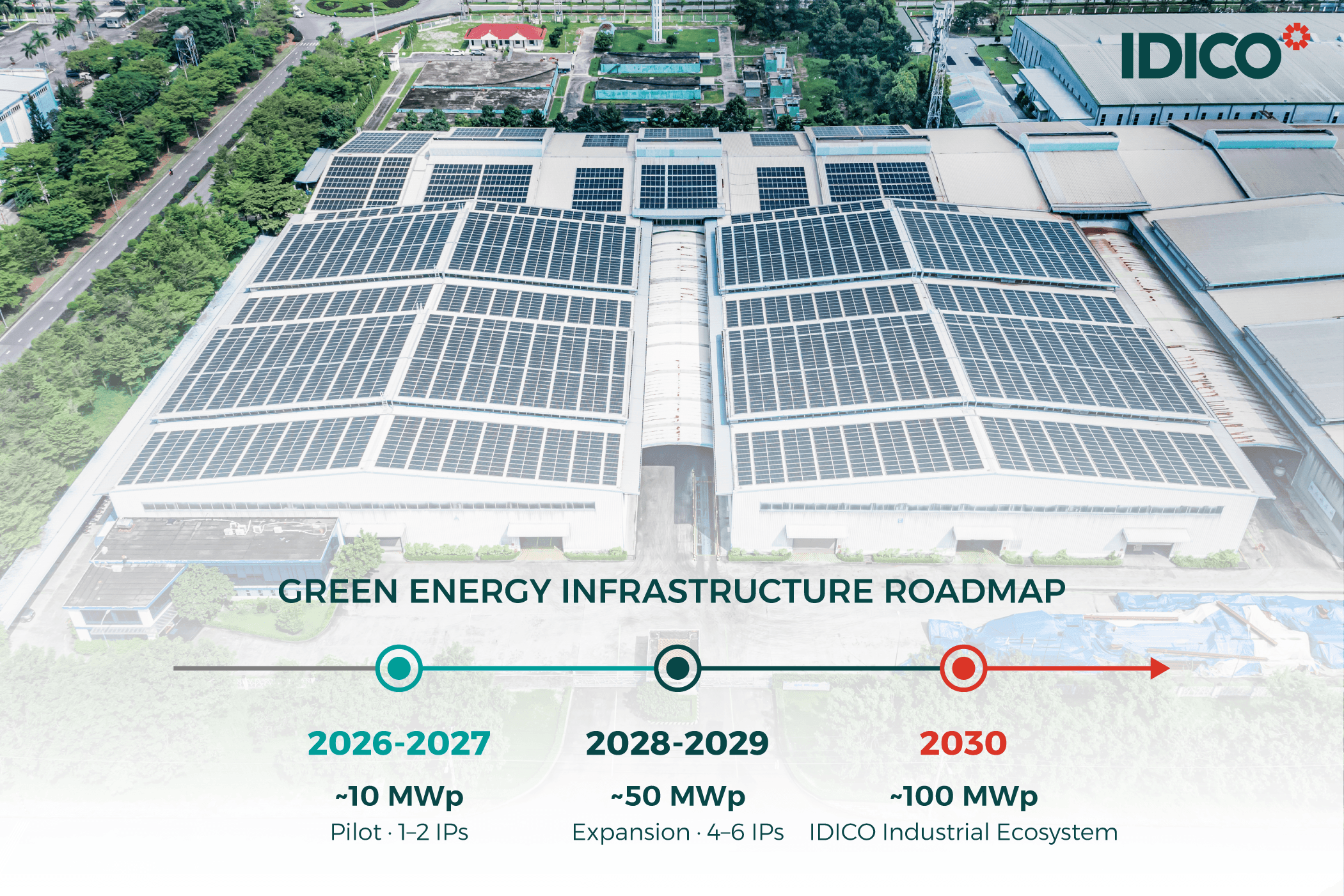
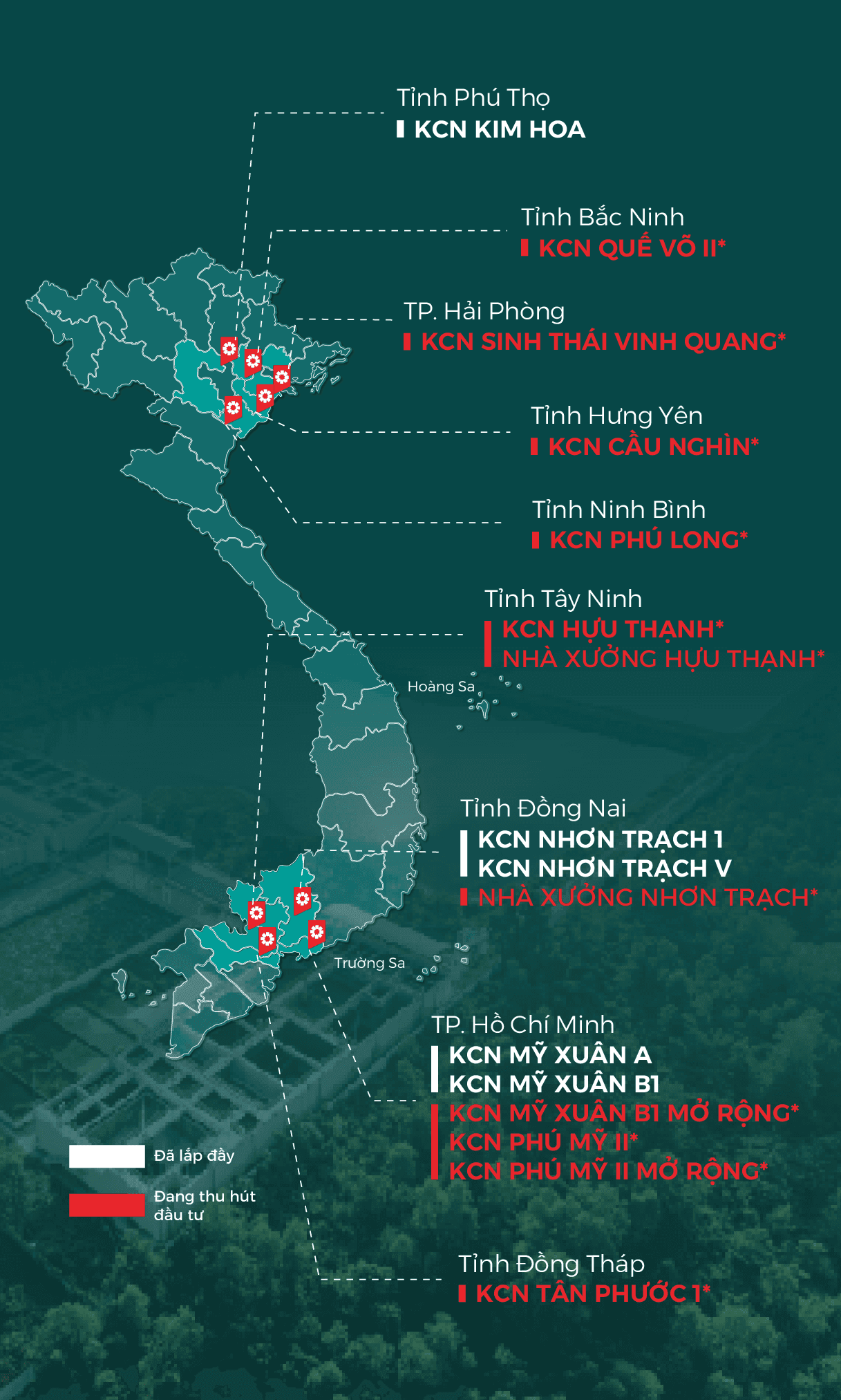
UDICO plans to prioritize IPs with high occupancy rates, significant electricity demand, and suitable rooftop areas. IDICO Nhon Trach 1 & V IPs in Dong Nai Municipality are among the priority locations and are expected to host the first pilot project in the municipality.
The proposed roadmap consists of three phases:
2026–2027: Pilot deployment of approximately 10 MWp across 1–2 IPs;
2028–2029: Expansion to approximately 50 MWp across 4–6 IPs;
By 2030: Targeting approximately 100 MWp of total capacity across IDICO’s industrial ecosystem.
In addition to rooftop solar, UDICO is also exploring energy storage solutions (BESS) and utility-scale solar projects suited to the conditions of each location. Combining on-site generation, energy storage, and appropriate power trading mechanisms could create further opportunities to optimize energy use across IPs.
TECHNOLOGY AND IMPLEMENTATION CAPABILITIES
Technology is one of the key factors determining the efficiency and safety of these solutions.
At the workshop, Huawei and Dong Phuong Energy, two of the participating partners, introduced technical solutions and implementation capabilities for commercial and industrial (C&I) clients. Huawei presented solar inverter systems and energy storage solutions, while Dong Phuong Energy contributed expertise in the on-site construction and installation of solar power systems.
These solutions are designed to improve power conversion efficiency, enhance safety in power management, and give businesses greater control over their energy use.
The collaboration between UDICO and technology partners such as Huawei provides a foundation for developing energy solutions tailored to the operational characteristics of IP businesses, connecting technology capabilities with investment, grid connection, and infrastructure operation expertise.
A SUSTAINABLE AND INTEGRATED INDUSTRIAL ECOSYSTEM
When deployed across IDICO’s industrial ecosystem, renewable energy solutions can become an integral part of the infrastructure ecosystem, supporting businesses in improving energy efficiency and adapting to evolving market requirements.
The target of reaching 100 MWp of rooftop solar capacity by 2030 represents a new direction for IDICO’s industrial ecosystem: transforming the advantages of infrastructure and operational capabilities into tangible energy value for IP tenants.
In the traditional IP model, electricity is a utility. In the future of industrial ecosystem, energy will become a competitive advantage.